
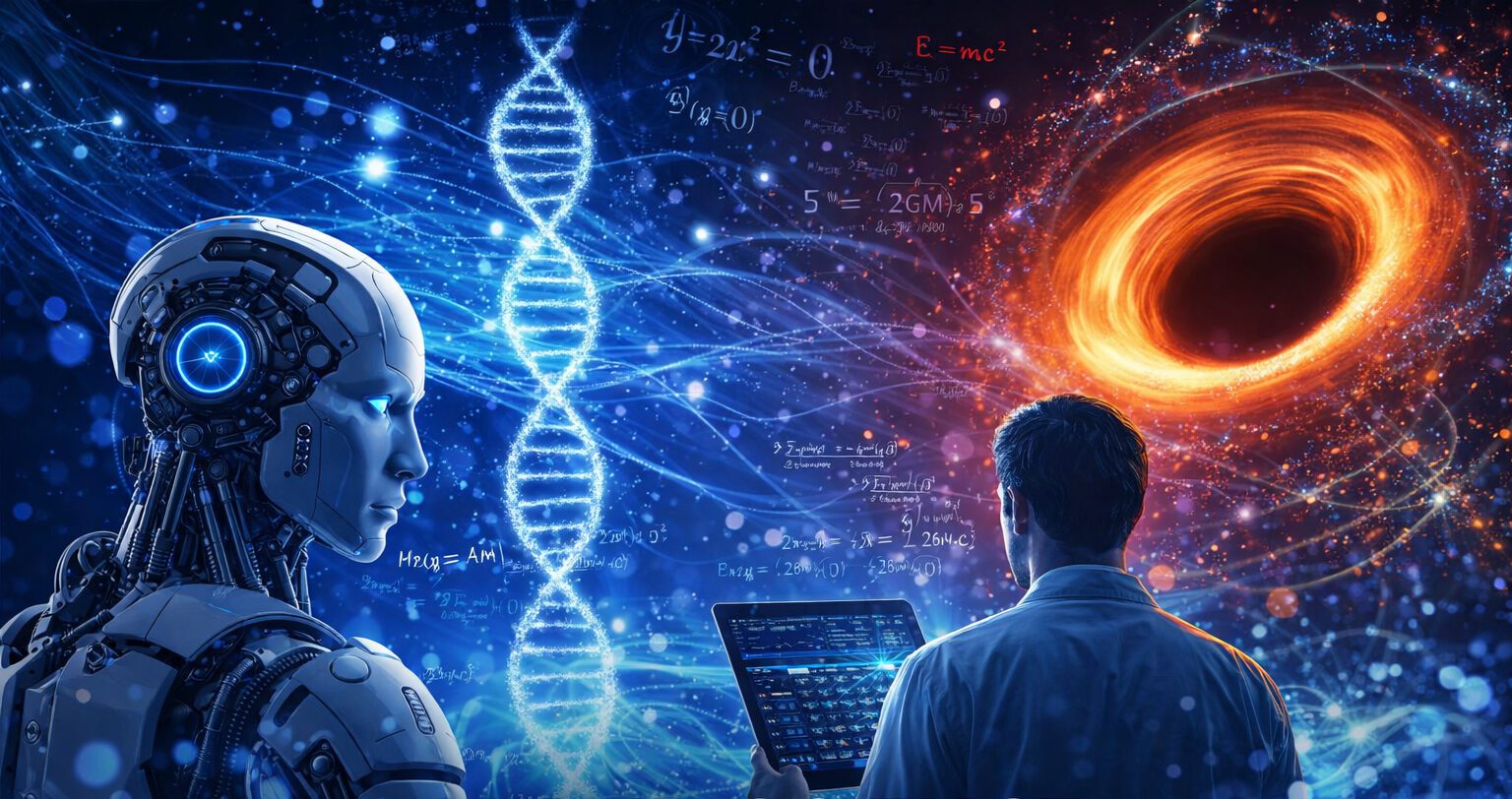
Artificial intelligence is no longer just a productivity tool — it is becoming an active collaborator in scientific discovery. A new January 2026 report shows how large language models like ChatGPT are already accelerating research across mathematics, physics, biology, and engineering.
The document presents real-world evidence of how researchers are using AI systems to explore hypotheses, debug complex mathematical reasoning, synthesize scientific literature, and even propose novel experimental directions. Rather than replacing scientists, these tools are reshaping how scientific work is done.
How Scientists Are Actually Using AI
Contrary to common assumptions, researchers are not using AI primarily to automate experiments or generate final answers. Instead, the most common uses fall into a few clear categories:
- Mathematical reasoning and proof exploration: AI helps researchers test conjectures, explore intermediate steps, and uncover alternative solution paths.
- Code and data analysis support: Scientists rely on AI to write, debug, and optimize research code, as well as to analyze complex datasets.
- Literature synthesis: AI systems help summarize large bodies of prior research, identify gaps, and connect ideas across disciplines.
- Conceptual clarification: Researchers use AI to explain unfamiliar techniques, translate between mathematical formalisms, and refine research questions.
Measuring Scientific Capability
The report highlights that evaluating AI for science requires more than standard benchmarks. While traditional tests measure factual recall, scientific work demands reasoning, creativity, and persistence.
To address this, new evaluations such as advanced mathematics competitions and graduate-level problem sets are being used to measure how well AI systems reason under uncertainty. These benchmarks show steady progress, particularly in symbolic reasoning and multi-step problem solving.
Case Studies Across Disciplines
Several real examples illustrate the impact of AI-assisted research:
- Mathematics: Researchers report using AI to explore conjectures and identify promising proof strategies, significantly reducing exploratory time.
- Physics: In fields such as gravitational physics and black hole research, AI assists with symbolic manipulation and equation checking.
- Biology: Scientists apply AI tools to experimental design, protein analysis, and hypothesis generation in early-stage research.
In each case, AI functions as a collaborator — proposing ideas, checking logic, and offering alternative perspectives — while final judgment remains firmly in human hands.
Implications for the Future of Science
The report argues that the greatest scientific gains will come not from fully automated discovery, but from close human–AI collaboration. As these systems improve, they are expected to lower barriers to entry, accelerate interdisciplinary research, and allow scientists to focus more on creative and conceptual work.
However, the document also stresses the importance of access, training, and infrastructure. Ensuring that researchers worldwide can effectively use these tools will be critical to realizing their full potential.
Conclusion
AI is rapidly becoming a foundational tool in modern science. From mathematics to molecular biology, it is changing how researchers think, experiment, and collaborate. While challenges remain, the evidence is clear: scientific discovery is entering a new era — one where humans and intelligent systems work side by side.
As AI continues to evolve, the question is no longer whether it belongs in science, but how we choose to integrate it responsibly and effectively.