
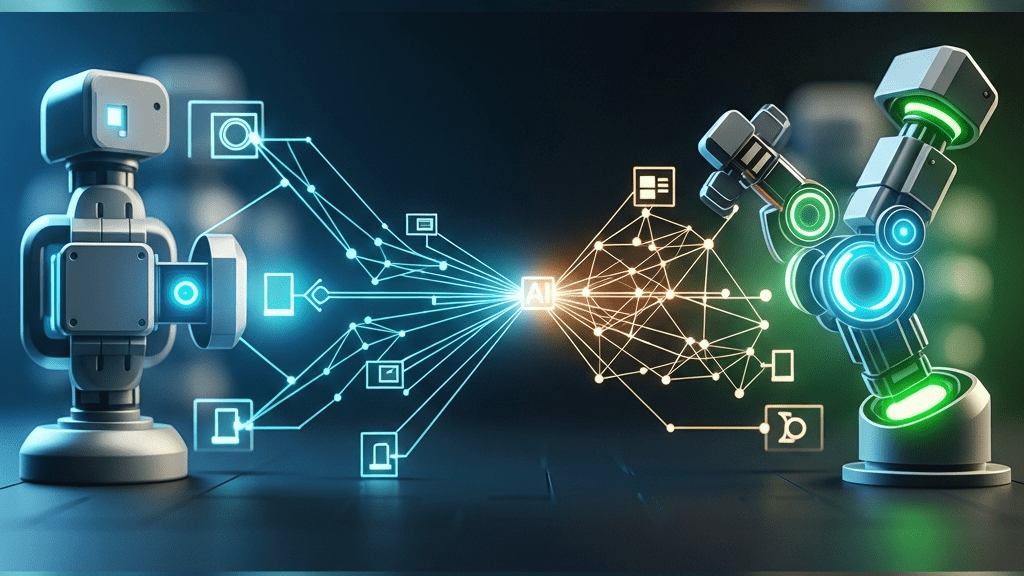
The landscape of artificial intelligence has shifted dramatically. As we move into 2026, the industry has transcended the era of simple generative text. We have officially entered a transformative phase defined by agentic AI, physical automation, and specialized intelligent systems that don’t just process information—they take action.
The Rise of Agentic AI: From Tools to Autonomous Workers
The most significant trend defining this year is the evolution of agentic AI. Unlike the passive assistants of previous years that required constant prompting, today’s agents are autonomous systems capable of executing complex, multi-step workflows without human intervention. This represents a fundamental shift from “AI that helps you” to “AI that works for you.”
- Market Growth: The agentic AI sector is skyrocketing, with projections moving from $5.2 billion in 2024 to an estimated $200 billion by 2034.
- Enterprise Efficiency: Real-world adoption is already yielding massive results. For instance, Danfoss recently reduced customer response times from 42 hours to nearly instant by automating 80% of their transactional decisions.
- Autonomous Logic: These agents can now make independent decisions, adapt to unforeseen challenges, and manage entire business processes from end to end.
Physical AI and the Humanoid Revolution
In 2026, AI has finally broken free from the screen. Physical AI—the integration of advanced machine learning with robotics—has moved from the laboratory to the factory floor. A landmark moment occurred in January 2026 when Boston Dynamics’ Atlas humanoid robot began field testing at Hyundai’s manufacturing facility in Georgia.
This breakthrough is powered by Vision-Language-Action (VLA) models. These models allow machines to perceive complex environments and translate visual data into precise physical movements. This isn’t just pre-programmed motion; it is intelligent, reactive physical labor.
Specialized Intelligence: The Power of VLA Models
As we demand more from AI, the industry is moving toward highly specialized, efficient models. A prime example is NVIDIA Alpamayo, a 10-billion-parameter Vision-Language-Action model. Specifically engineered for autonomous driving, Alpamayo incorporates “chain-of-thought” reasoning to navigate complex road scenarios with human-like intuition.
The shift toward these compact yet powerful models means that enterprise-grade performance no longer requires massive, generic LLMs. Instead, businesses are deploying surgical, task-oriented intelligence that delivers higher accuracy and lower latency.
What This Means for the Future
The transition to agentic and physical AI is redefining productivity across every global industry. For businesses, the focus has shifted from experimenting with chatbots to deploying autonomous workforces. As we look further into 2026, the boundary between digital intelligence and physical execution will continue to blur, creating a world where AI is a proactive partner in our physical and professional reality.
Source: Read the full article here.