
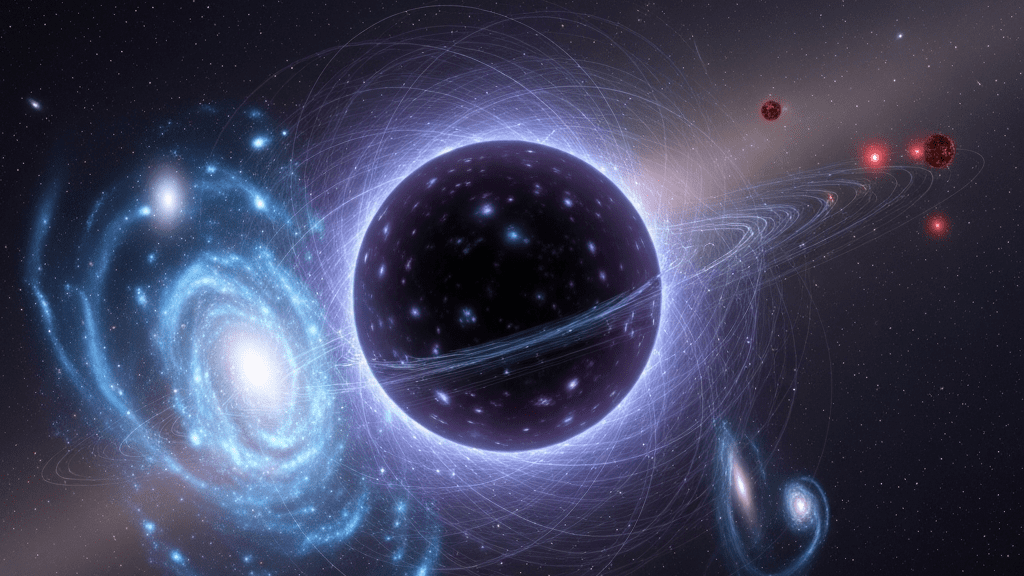
The James Webb Space Telescope (JWST) has fundamentally disrupted our understanding of the early universe. Since its deployment, it has captured images of objects that shouldn’t exist according to our current models: ultra-bright “blue monster” galaxies, enigmatic “little red dots,” and supermassive black holes that appeared far too early in cosmic history. These discoveries have left astrophysicists scrambling for a unifying theory.
A groundbreaking new study from researchers at Colgate University, the University of Pennsylvania, and the University of Texas at Austin suggests we’ve been looking for the wrong kind of stars. The answer might lie in an exotic, hypothetical object: the Dark Star.
The Physics of a Dark Matter Engine
In the standard model of cosmology, the first stars were powered by nuclear fusion. However, these new findings suggest that the very first stellar objects might have been powered by dark matter annihilation. Born within the dense centers of dark matter microhalos, these “Dark Stars” would look nothing like the stars we see today.
Instead of the compact, fusion-driven cores of modern stars, Dark Stars are fueled by the energy released when dark matter particles collide and destroy one another. This unique energy source provides sufficient internal pressure to allow the star to grow to massive proportions—reaching masses millions of times that of our Sun—without collapsing prematurely. Because they don’t rely on fusion, they can grow much faster and larger than any traditional star.
Solving the Three-Headed Cosmic Mystery
The research team, led by Assistant Professor Cosmin Ilie, posits that Dark Stars act as a “missing link” that solves three of JWST’s most persistent headaches simultaneously:
- The Blue Monsters: These are ultra-bright, high-redshift galaxies that appear far more evolved than they should be just a few hundred million years after the Big Bang. Dark Stars provide the massive luminosity required to explain these observations.
- The Little Red Dots: JWST has spotted compact, reddish objects in the deep past. The study suggests these may actually be individual, supermassive Dark Stars rather than entire galaxies.
- The Seed Problem: Perhaps the most significant mystery is the presence of supermassive black holes (SMBHs) in the early universe. Standard stellar evolution takes too long to create an SMBH. However, when a massive Dark Star eventually exhausts its dark matter fuel, it collapses directly into a massive black hole seed, giving these giants a significant “head start.”
The Smoking Gun: UHZ1
The study highlights UHZ1, a record-breaking galaxy located 13.2 billion light-years away. UHZ1 contains a supermassive black hole that is far too large for its age if it started from a normal stellar seed. The researchers demonstrate that UHZ1 is a prime candidate for an environment where a Dark Star once lived, collapsed, and seeded the quasar we see today.
A New Frontier in Astrophysics
While Dark Stars remain hypothetical, the evidence is mounting. If confirmed, this discovery wouldn’t just solve the mysteries of the early universe; it would provide the first indirect evidence of what dark matter actually is and how it interacts with baryonic matter. We are witnessing a paradigm shift where the dark and visible components of our universe are more deeply intertwined than we ever dared to imagine. As JWST continues to peer back toward the Cosmic Dawn, the case for these exotic dark-matter-powered giants only grows stronger.
Source: Read the full article here.