Astronomers and space enthusiasts have a new reason to marvel at the prowess of the Hubble Space Telescope. In a breathtaking new image, Hubble has peeled back the layers of the Egg Nebula, a rare and fleeting cosmic phenomenon located roughly 1,000 light-years away in the constellation Cygnus. This isn’t just a pretty picture; it is a high-resolution window into the violent, beautiful, and highly complex end-of-life stages of a Sun-like star.
A Rare Window into Stellar Metamorphosis
The Egg Nebula is a “pre-planetary nebula,” a brief evolutionary phase that lasts only a few thousand years—a mere blink of an eye in cosmic time. Despite the name, these structures have nothing to do with planets. Instead, they represent the transition of a dying star as it sheds its outer layers before becoming a full-fledged planetary nebula. As the first and closest object of its kind ever identified, the Egg Nebula provides an unparalleled laboratory for studying stellar death.
Hubble’s Wide Field Camera 3 (WFC3) has captured the nebula in unprecedented detail, revealing a striking interplay of light and shadow. At the heart of this structure lies a central star, though you won’t see it directly. It remains completely entombed within a dense, opaque disk of dust—the cosmic “yolk” of the nebula.
The Mechanics of a Dying Star
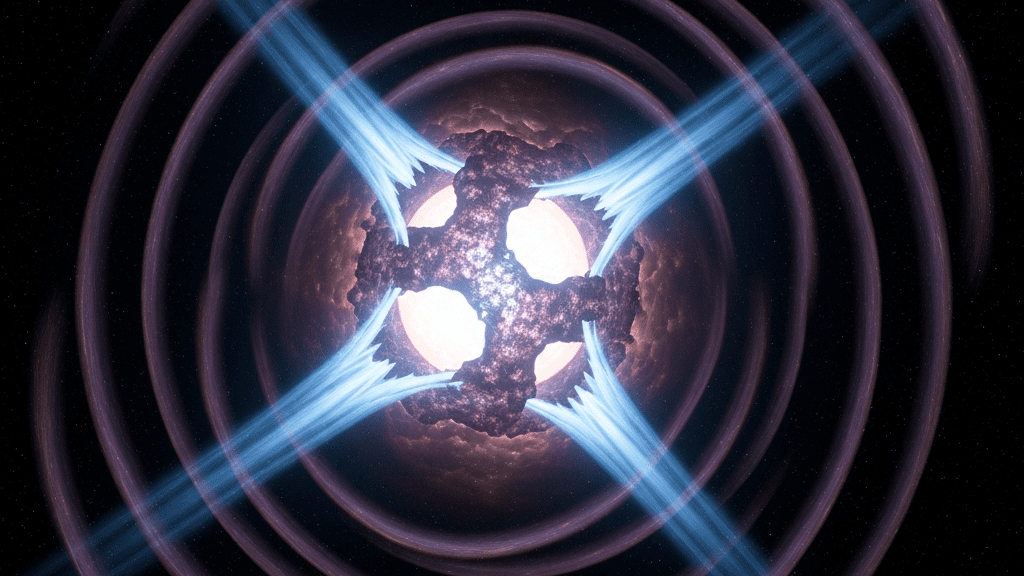
The visual spectacle we see is created by a fascinating process of light leakage. Intense radiation from the hidden star manages to escape through polar openings, or “eyes,” in the surrounding dust shell. These twin beams blast outward, illuminating the surrounding gas and dust like searchlights in a foggy night. Key features revealed in this latest observation include:
- Glowing Lobes: Fast-moving polar outflows that punch through the surrounding material, carving out dramatic shapes.
- Concentric Ripples: Symmetrical arcs of dust that radiate outward, suggesting the star has been pulsating or ejecting material in regular intervals for centuries.
- The Dusty Disk: A massive ring of material expelled just a few hundred years ago, which currently hides the star from our direct view.
Hidden Architects: The Case for Companion Stars
For experts, the most intriguing aspect of the Egg Nebula is its complex symmetry. The precision of the twin beams and the delicate ripples in the dust suggest that the central star isn’t acting alone. Astronomers suspect that one or more unseen companion stars are lurking within the central dust cocoon. The gravitational influence of these companions likely acts as a cosmic sculptor, shaping the outflows and creating the intricate patterns we see today.
As this stellar system continues to evolve, the central star will eventually become hot enough to ionize the surrounding gas, causing it to glow with its own light. For now, we are witnessing the “pre-dawn” of that transformation—a dazzling, dust-filled transition that reminds us of the dynamic nature of our universe. Hubble continues to prove that even after decades in orbit, it remains our premier tool for unmasking the most hidden corners of the galaxy.
Source: Read the full article here.