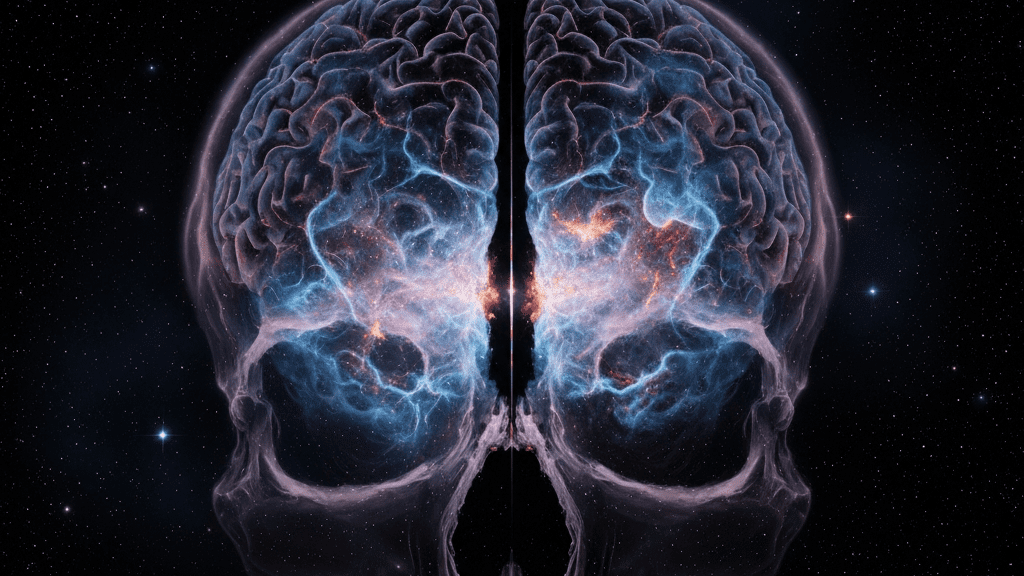
The James Webb Space Telescope (JWST) has once again redefined our understanding of stellar evolution, capturing a breathtakingly high-resolution look at the nebula PMR 1. Nicknamed the "Exposed Cranium," this celestial marvel offers a hauntingly beautiful glimpse into the final moments of a dying star. Through the lens of Webb’s sophisticated infrared suite, what once appeared as a faint smudge in space has been revealed as a complex, brain-shaped structure floating within a gossamer "skull" of expelled gas.
Beyond Spitzer: A New Era of Infrared Clarity
While the Spitzer Space Telescope first detected PMR 1 over a decade ago, its infrared resolution was limited. Webb’s recent observations using the Near-Infrared Camera (NIRCam) and the Mid-Infrared Instrument (MIRI) provide an unprecedented leap in detail. By peering through the dust that obscures visible light, Webb has transformed our view of this object from a blurry infrared signature into a masterclass of cosmic morphology. This isn’t just a pretty picture; it’s a high-definition map of a star’s terminal mass-loss events.
The Anatomy of a Dying Star
The moniker "Exposed Cranium" is no hyperbole. The nebula’s unique structure mimics the biological complexity of a human brain, categorized by several distinct features that Webb has now brought into sharp focus:
- The Cerebral Hemispheres: A prominent vertical dark lane bisects the nebula into two distinct lobes, creating an uncanny resemblance to the left and right hemispheres of a brain.
- The Protective "Skull": An outer shell composed primarily of hydrogen represents the star’s earlier evolutionary phases, where gas was expelled at high velocities.
- The Inner Core: A chaotic mix of gases and intricate filaments within the "brain" region suggests a volatile chemical environment where heavy elements are being recycled back into the interstellar medium.
Powerful Jets and Stellar Outflows
What creates such a specific, bifurcated shape? Expert analysis of the MIRI data suggests that the central star is driving powerful, twin bipolar jets. These outflows of material shoot out in opposite directions, carving out the central dark lane and sculpting the surrounding gas into the lobes we see today. We are witnessing the "last gasps" of a star that has exhausted its nuclear fuel, shedding its outer layers and transitioning toward its final state as a white dwarf.
A Brief, Dramatic Phase
In the grand timeline of the universe, the phase Webb is capturing in the Exposed Cranium is incredibly fleeting. These planetary nebulae exist for only a few tens of thousands of years—a mere blink of an eye in cosmic terms. By studying PMR 1, astronomers are gaining critical insights into the dynamics of stellar winds and the enrichment of the galaxy. It is a poignant reminder that even in death, stars provide the raw materials for the next generation of celestial bodies.
Source: Read the full article here.