
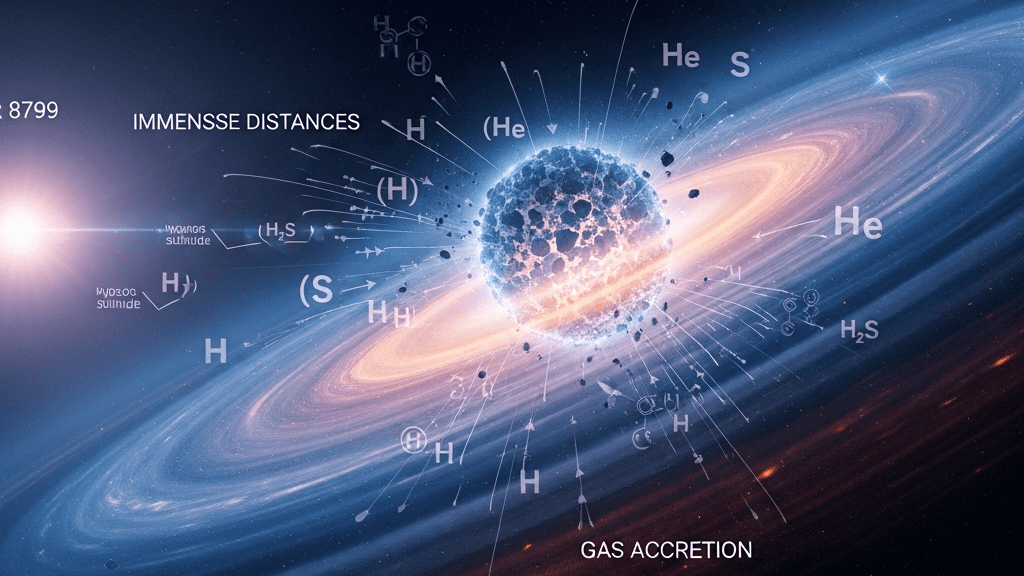
The James Webb Space Telescope (JWST) has once again fundamentally shifted our understanding of the cosmos. In a stunning new study of the HR 8799 system—a young, sun-like star located 133 light-years from Earth—astronomers have uncovered evidence that could redefine the very boundary between massive planets and “failed stars.” By peering through the thick atmospheres of worlds five to ten times the mass of Jupiter, JWST is settling a long-standing debate about how the universe’s largest planets come to be.
The HR 8799 System: A Cosmic Laboratory
The HR 8799 system is legendary in the astronomical community. It hosts four behemoth gas giants orbiting at immense distances from their parent star. For years, these worlds have sat in a scientific “gray area.” Because of their extreme mass, they exist right on the fuzzy line that separates true planets from brown dwarfs—substellar objects that are large enough to fuse deuterium but too small to ignite like stars.
The central question has always been one of origin: Did these giants form like stars through the rapid collapse of gas clouds, or did they grow slowly, piece by piece, like our own Jupiter? New spectral analysis from JWST provides a definitive clue.
The Smoking Gun: Hydrogen Sulfide
Using JWST’s unparalleled infrared capabilities, researchers detected hydrogen sulfide (H2S) in the atmosphere of HR 8799 c. While H2S might be better known on Earth for its “rotten egg” smell, in deep space, it serves as a critical chemical fingerprint. The presence of this molecule, along with other chemical signatures, suggests that these planets formed through a process known as core accretion.
How Core Accretion Scales Up
Core accretion is the traditional, bottom-up model of planet formation. It follows a specific sequence that scientists previously thought might be impossible for planets this massive and this far from their star:
- Solid Clumping: Heavy elements and ices slowly stick together within a protoplanetary disk to form a dense, solid core.
- Gas Capture: Once the core reaches a critical mass, its gravity becomes strong enough to rapidly pull in vast amounts of surrounding hydrogen and helium gas.
- Chemical Enrichment: Because the planet starts with a solid core, its atmosphere ends up enriched with specific elements—like the sulfur found in H2S—in ratios that differ from the parent star.
Previously, many theorists argued that at such extreme distances from a star, the material in a protoplanetary disk would be too sparse to build a core before the gas dissipated. The JWST data proves that even at the furthest reaches of a solar system, nature finds a way to build giants from the ground up.
Redefining the Planetary Limit
This discovery is a major win for planetary science. It suggests that the “mass limit” for planet formation is much higher than we once believed. If a world ten times the mass of Jupiter can form via core accretion, it shares a closer lineage with Earth and Jupiter than it does with the stars. This insight allows astronomers to better categorize the thousands of exoplanets being discovered, moving us one step closer to a comprehensive theory of how every object in our galaxy—from rocky marbles to gas giants—is assembled.
Source: Read the full article here.