In the fast-paced world of JavaScript development, staying ahead of the curve means more than just writing great code—it means understanding the foundation your applications sit on. Node.js is the backbone of the modern web, and its sophisticated release strategy is designed to provide the perfect balance between cutting-edge innovation and rock-solid stability. Let’s dive deep into how you can leverage the Node.js release cycle to ensure your enterprise applications remain secure, performant, and future-proof!
The Lifecycle of a Release: Current vs. LTS
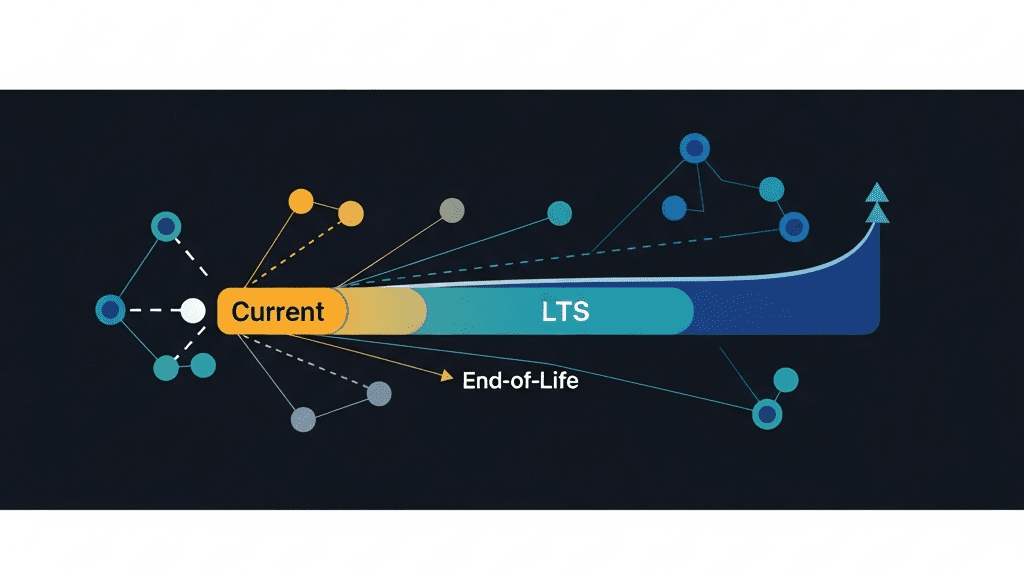
Node.js follows a predictable and strategic release rhythm. Major versions initially enter a Current status for six months. This is a thrilling time for the community! It gives library authors the necessary window to test, iterate, and add support for the latest features. However, there is a distinct fork in the road depending on the version number:
- Odd-numbered releases (e.g., v23, v25): These are short-lived. Once their six-month window closes, they move to End-of-Life (EoL) status. They are perfect for testing new features but should be avoided for stable production environments.
- Even-numbered releases (e.g., v20, v22, v24): These are the heavy hitters. After their time as “Current,” they transition into Active LTS (Long-Term Support). This status is a gold standard for general use, guaranteeing that your application is backed by critical bug fixes and security updates.
Production-Ready Strategy: Why LTS Matters
As experts in the field, we know that stability is non-negotiable for production workloads. The Long-Term Support (LTS) designation typically guarantees 30 months of critical support. When you architecting for the long haul, your strategy should focus exclusively on:
- Active LTS: The sweet spot for new production deployments, offering the latest stable features.
- Maintenance LTS: The final phase where the focus shifts entirely to critical security patches and vital bug fixes—ideal for legacy systems that require maximum uptime with minimal changes.
Looking at the Horizon: From Iron to Krypton
The Node.js roadmap is looking more robust than ever. We are currently seeing a powerful lineup of versions that cater to every need. v20 (Iron) and v22 (Jod) are currently holding the line in Maintenance LTS, providing a reliable foundation for millions of apps. Meanwhile, v24 (Krypton) is stepping up as the new Active LTS powerhouse, and v25 is already on the horizon to push the boundaries of what’s possible in the “Current” phase.
Official vs. Community: Choosing Your Installation Method
Flexibility is a core tenet of the Node.js ecosystem. To empower developers, the project now distinguishes between “Official” and “Community” installation methods. This clarity helps you choose the tool that best fits your workflow, whether you prefer the raw power of the CLI or the convenience of a package manager like brew or nvm.
For a method to be deemed Official, it must meet rigorous standards:
- New releases must be available simultaneously with the official Node.js release.
- Maintainers must maintain a direct, close relationship with the Node.js project.
- Communication channels must be open and transparent to ensure rapid responses to ecosystem changes.
Whether you are upgrading a legacy monolith or spinning up a new microservice, understanding these release tiers ensures you are always making the most informed decision for your tech stack. Keep your engines running on LTS, and keep your eyes on the Current releases for the future of JavaScript!
Source: Read the full article here.