The data center landscape just experienced a seismic shift. For years, NVIDIA has been the undisputed king of the GPU, while Intel and AMD battled for supremacy in the server CPU market. That era of specialization is officially over. NVIDIA has announced that its revolutionary “Vera” CPU is breaking free from its GPU-integrated roots to enter the market as a standalone competitor to the industry-standard Intel Xeon and AMD EPYC processors.
This isn’t just a minor product expansion; it is a full-scale assault on the traditional x86 stronghold. CEO Jensen Huang recently confirmed that Vera will be offered as a standalone part of the modern infrastructure, allowing enterprise customers to run their entire computing stack on NVIDIA silicon. For those of us who have been tracking the evolution of the Arm ecosystem, this marks the moment NVIDIA moves from being a component provider to a total-platform architect.
The Power of the Olympus Core
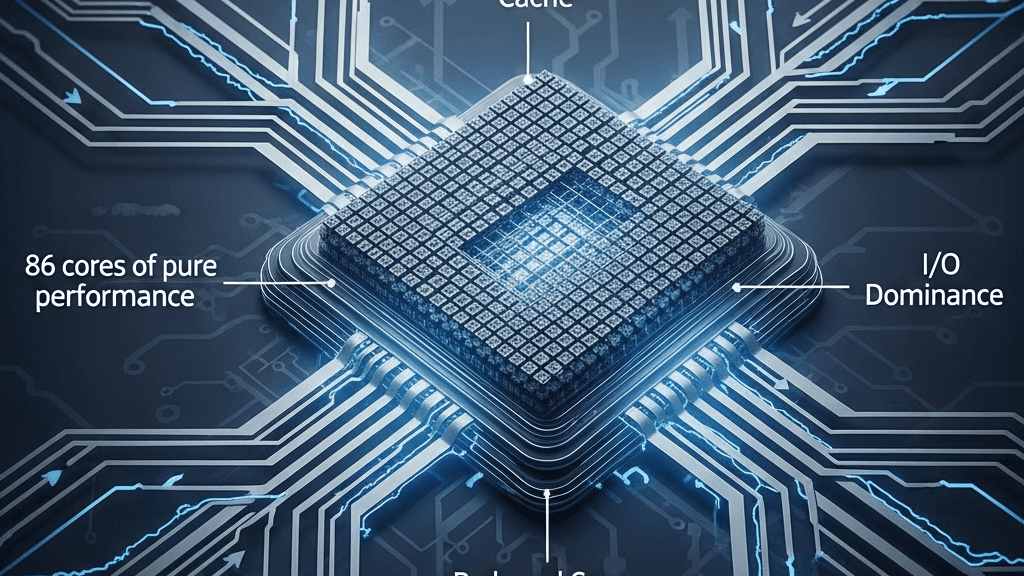
At the heart of Vera lies a masterclass in silicon engineering: the “Olympus” core. Built on the Armv9.2 architecture, Vera features 88 custom cores that utilize a sophisticated technology known as Spatial Multithreading. By physically partitioning resources, Vera can handle 176 threads simultaneously, offering a level of parallel efficiency that traditional SMT often struggles to match.
But raw thread count is only half the story. NVIDIA has optimized these cores for the modern AI-driven world. Key technical highlights include:
- Native FP8 Support: Allowing specific AI workloads to run directly on the CPU, reducing the need to offload every minor task to the GPU.
- 6×128-bit SVE2 Implementation: Providing massive vector processing capabilities that give Vera a distinct advantage in scientific computing and complex data processing.
- Monolithic Die Design: Unlike the chiplet architectures favored by competitors, Vera utilizes a unified monolithic die to virtually eliminate the latency penalties associated with inter-chiplet communication.
Unprecedented Memory and Interconnect Throughput
In the world of high-performance computing (HPC), compute power is often throttled by data movement. NVIDIA has addressed this bottleneck head-on. Vera boasts a staggering 1.2 TB/s of memory bandwidth, supporting up to 1.5 TB of LPDDR5X memory. While we are still waiting for confirmation on whether Vera will support traditional DDR5 RDIMMs, the move toward SOCAMM LPDDR5X suggests a focus on maximizing power efficiency and density.
The internal plumbing is equally impressive. A second-generation Scalable Coherency Fabric delivers 3.4 TB/s of bisection bandwidth, ensuring that the 88 Olympus cores are never starved for data. Furthermore, for those who do pair Vera with GPUs, the integrated second-generation NVLink Chip-to-Chip (C2C) technology provides 1.8 TB/s of coherent bandwidth to external “Rubin” GPUs.
A New Era for the Data Center
The implications of a standalone NVIDIA CPU are profound. Cloud providers like Coreweave are already poised to be early adopters, signaling a high level of confidence in the platform’s ability to handle mission-critical infrastructure. By offering a CPU that is designed from the ground up for the AI era, NVIDIA is forcing Intel and AMD to defend their territory on entirely new terms.
Vera isn’t just another CPU; it’s a declaration of independence. For the first time, the “NVIDIA Factory” is complete, offering a top-to-bottom stack that promises to redefine what we expect from server-grade performance. The battle for the heart of the data center has officially begun.
Source: Read the full article here.