The frontier of space exploration just got a massive intelligence upgrade. In a historic milestone for planetary science, NASA’s Perseverance rover has officially completed its first-ever drives on the Red Planet planned entirely by artificial intelligence. This wasn’t just another stroll across the Jezero Crater; it represents a fundamental shift in how we explore the cosmos, moving from rigid manual sequencing to dynamic, autonomous decision-making.
A Leap in Extraterrestrial Autonomy
Executed on December 8 and 10, 2025, these landmark demonstrations saw Perseverance navigate the rugged rim of the Jezero Crater using routes generated by generative AI. Traditionally, rover planners at the Jet Propulsion Laboratory (JPL) manually analyze imagery and data to plot specific waypoints—the fixed locations where the rover pauses to receive new instructions. This is a painstaking process that requires hours of human expertise to ensure the safety of the multibillion-dollar hardware.
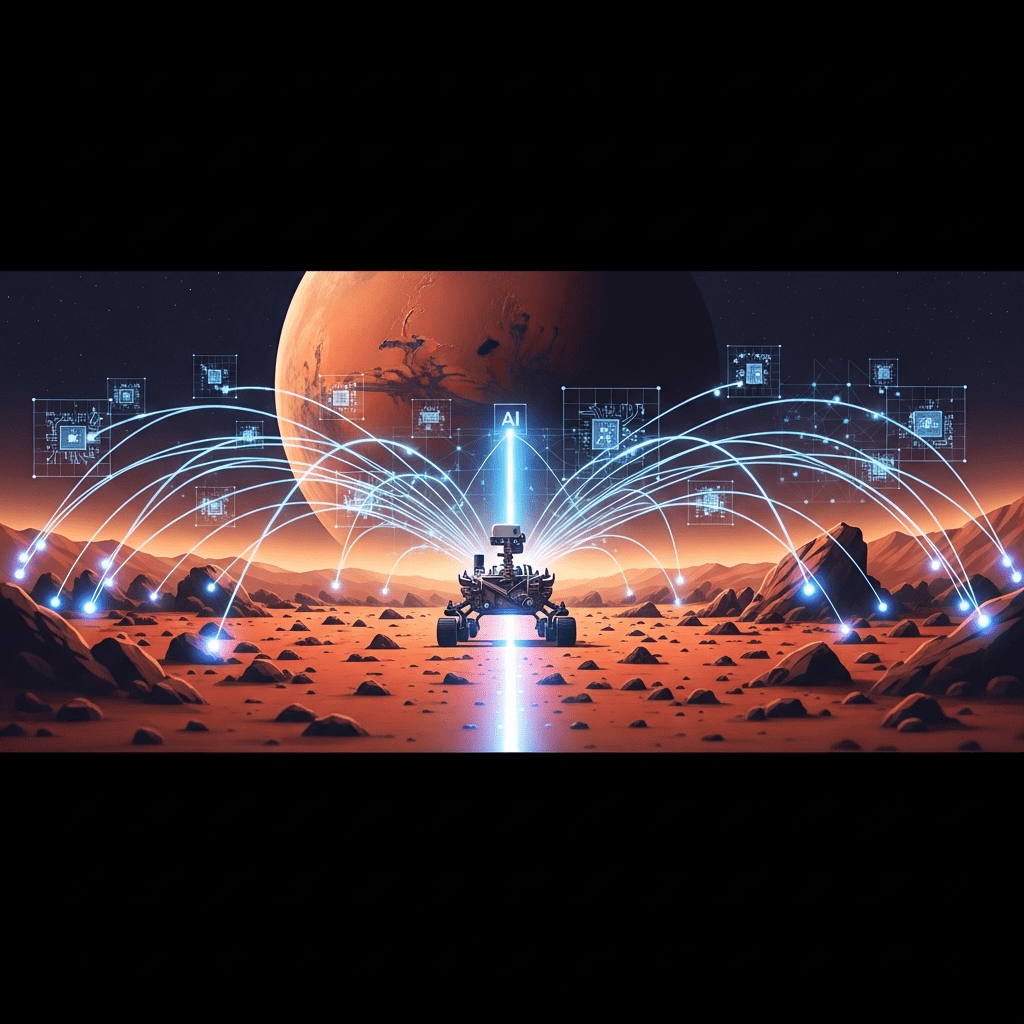
During this mission, the AI took the wheel. Leveraging advanced vision-language models (VLMs), the system analyzed the same high-resolution imagery and topographical data that human planners use. By processing this information through JPL’s vast surface mission datasets, the AI successfully generated safe, efficient waypoints that allowed Perseverance to navigate complex terrain without direct human intervention.
The Tech Behind the Mission: Claude on Mars
This achievement is the result of a high-stakes collaboration between JPL’s Rover Operations Center (ROC) and Anthropic. The team utilized Anthropic’s Claude AI models to bridge the gap between visual perception and actionable logic. This specific type of generative AI—a vision-language model—is uniquely suited for the task because it can “see” the terrain and translate those visual cues into the complex spatial reasoning required for route planning.
The demonstration didn’t just prove the AI could find a path; it proved it could find a safe and optimal path. NASA released reconstructions of the drive showing the rover’s internal logic: a height map of the terrain, various path options being considered in real-time, and the final selection of waypoints that guided the six-wheeled scientist across the Martian surface.
Why AI is Essential for Deep Space
With Mars sitting at an average distance of 140 million miles from Earth, communication lag is a constant hurdle. Depending on the planetary alignment, it can take anywhere from 5 to 20 minutes for a signal to travel one way. This makes real-time remote piloting impossible. By shifting the burden of route planning to on-board or near-mission AI, NASA is unlocking several critical advantages:
- Increased Efficiency: Rovers can spend less time waiting for instructions and more time moving toward high-value science targets.
- Enhanced Safety: AI can rapidly respond to unexpected terrain features that might not be visible from orbital imagery.
- Greater Science Return: Faster navigation means more sites visited and more samples collected during the mission’s lifespan.
- Scalability: As we move toward exploring the outer moons of Jupiter and Saturn, where the communication lag is even greater, full autonomy will be a requirement, not a luxury.
The Future of Planetary Operations
NASA Administrator Jared Isaacman highlighted the significance of this test, noting that autonomous technologies are vital as the distance between the explorer and Earth grows. The success of the Perseverance demonstration proves that generative AI can be deployed responsibly and effectively in mission-critical environments.
We are witnessing the transition from rovers that are remotely controlled to rovers that are truly autonomous explorers. As these vision-capable models continue to evolve, the potential for discovery on Mars—and beyond—is limited only by the intelligence we send with them.
Source: Read the full article here.