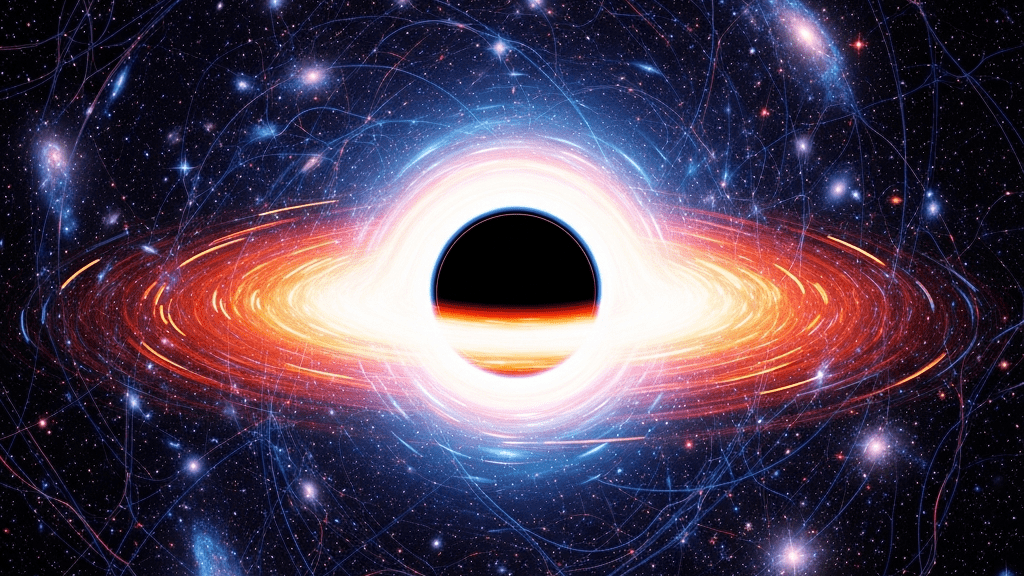
For decades, cosmologists have grappled with a persistent paradox: how did the universe’s earliest supermassive black holes reach masses millions or billions of times that of our Sun so shortly after the Big Bang? According to our standard models of physics, there is a theoretical “speed limit” to how fast a black hole can feast. But a groundbreaking new discovery by an international team of astronomers has just shattered those expectations.
Using the Subaru Telescope’s near-infrared spectrograph, researchers from Waseda University and Tohoku University have identified a rare, high-redshift quasar that is essentially “overclocking” its own growth. This isn’t just a minor deviation; this black hole is devouring matter at a staggering 13 times the traditional theoretical limit, providing us with a rare glimpse into the chaotic growth spurts of the early cosmos.
The Eddington Limit: A Rule Meant to be Broken?
To understand why this discovery is so significant, we have to look at the Eddington limit. In a typical active galactic nucleus, there is a delicate balance at play. As gas spirals into a black hole, it heats up and emits intense radiation. This outward radiation pressure acts as a brake, pushing against the infalling matter. If the black hole feeds too fast, the radiation pressure should, in theory, blow the food source away.
However, this newly discovered quasar is operating under a regime known as super-Eddington accretion. By tracking the motion of gas near the event horizon—specifically by analyzing the Mg II emission lines—the team confirmed that this object is ignoring the standard cosmic brakes. This 13-fold increase in growth speed offers a compelling solution to how the giants of the early universe formed: they didn’t grow at a steady pace; they experienced violent, high-speed growth spurts.
A Rare “Triple Threat” of Cosmic Phenomena
What makes this specific quasar even more extraordinary is that it isn’t just growing fast—it’s doing everything else at once. Historically, many astrophysical models suggested that certain traits were mutually exclusive during high-growth phases. This discovery defies those models by exhibiting three major characteristics simultaneously:
- Extreme Accretion: The 13x Eddington growth rate mentioned above.
- Intense X-ray Emission: Observations show a bright, high-energy corona of hot plasma surrounding the black hole.
- Powerful Radio Jets: The system is launching narrow, high-velocity streams of particles into deep space at radio wavelengths.
Finding a system that combines super-Eddington growth with both a bright X-ray corona and a radio jet is incredibly rare. It suggests that the internal structures of these engines—the accretion disk, the corona, and the magnetic fields that launch jets—can remain stable even under the extreme stress of hyper-rapid growth.
Unlocking the Secrets of the Early Universe
This discovery is a major win for observational astronomy. By catching this black hole during a brief, unstable phase of its evolution, researchers are finally seeing the “missing link” in galactic history. This suggests that the early universe was a much more dynamic and volatile place than our current steady-state models might imply.
As we continue to refine our data from instruments like the Subaru Telescope and the James Webb Space Telescope, we are moving closer to a unified theory of black hole evolution. We are learning that when it comes to the early universe, the rules of the road were often treated more like suggestions.
Source: Read the full article here.