The TypeScript ecosystem is standing on the precipice of its most significant architectural shift since its inception. Microsoft has officially announced that TypeScript 7—codenamed “Corsa”—will move away from its JavaScript roots to be implemented natively in Go. This isn’t just a minor update; it is a complete reimagining of the toolchain designed to eliminate the performance bottlenecks that have long plagued massive enterprise codebases.
The End of the JavaScript-Based Era
With this announcement, TypeScript 6.0 marks the final version of the compiler implemented in JavaScript. Microsoft has made it clear that there will be no version 6.1. Instead, the team is pivoting entirely to the native Go-based implementation. While TypeScript 6.0 will continue to receive critical security patches and compatibility updates, all major innovation is now flowing into the “Corsa” pipeline.
Performance: Breaking the 10x Barrier
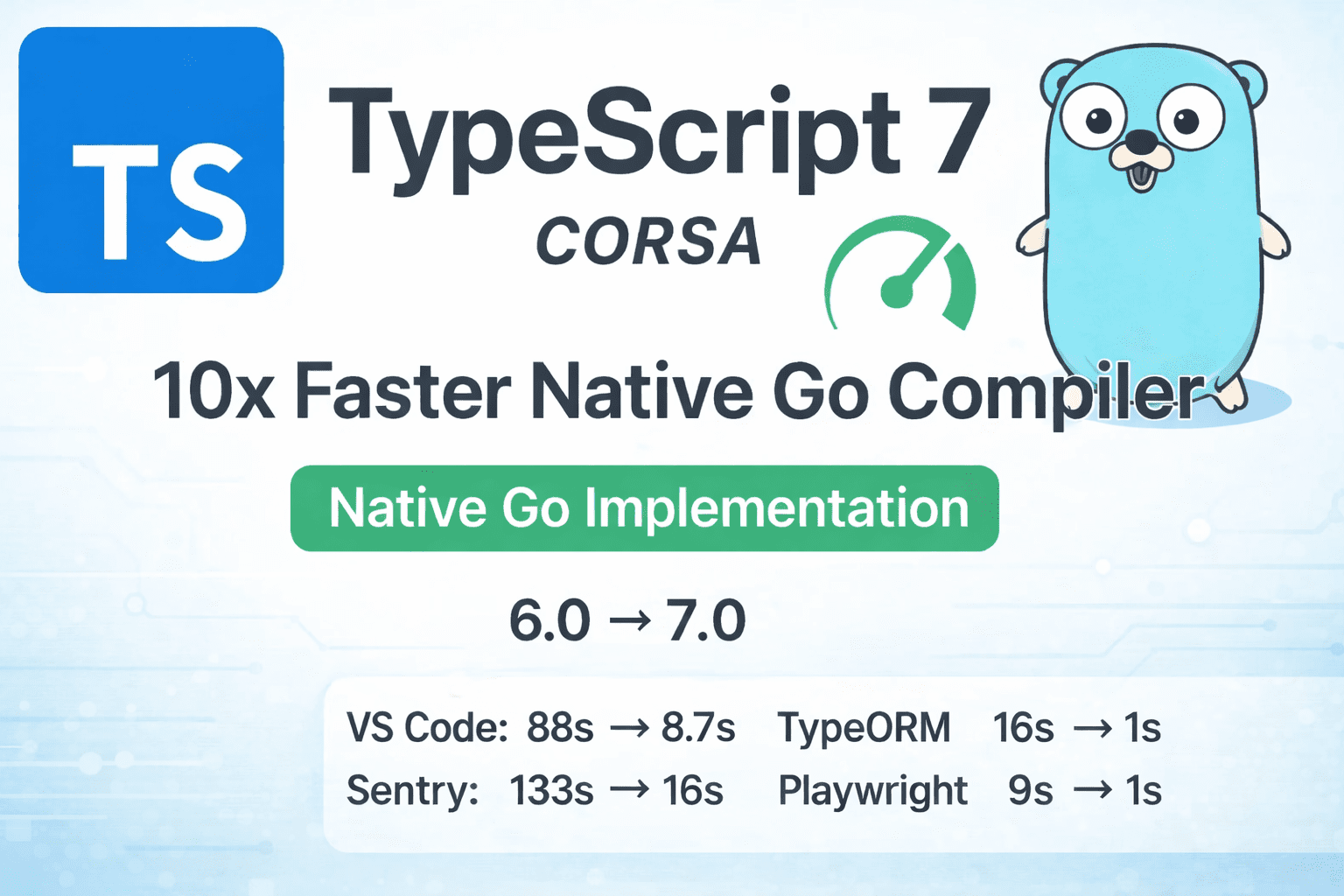
The headline feature of TypeScript 7 is, without question, its raw speed. By moving to a native Go toolchain (dubbed tsgo), Microsoft has achieved breathtaking performance gains. In real-world benchmarks on massive repositories, the results speak for themselves:
- VS Code: Build times plummeted from 89.11s to just 8.74s (10.2x faster).
- Sentry: Reduced from 133.08s to 16.25s (8.19x faster).
- TypeORM: Dropped from 15.80s to a near-instant 1.06s (9.88x faster).
- Playwright: Improved from 9.30s to 1.24s (7.51x faster).
For developers working in enterprise environments, this translates to a fundamental shift in daily workflow: build times that previously took minutes now resolve in seconds, effectively removing the “context-switch” tax during development.
Rewritten Language Services for a Modern IDE
Beyond the compiler, TypeScript 7 introduces a completely rewritten language service. Utilizing a parallel architecture with shared memory, the new system addresses the “crashy” behavior often seen in large-scale projects. Key improvements include:
- Significantly reduced memory footprint across all project sizes.
- Faster load times for both TypeScript and JavaScript projects.
- Rock-solid stability for core IDE features like auto-imports, renaming, and signature help.
- Full support for Project References in both TS and JS codebases.
A New Toolchain: Introducing tsgo
The new tsgo compiler is reaching feature parity with its predecessor, supporting modern development workflows out of the box. High-performance features such as --incremental mode for rapid rebuilds and --build mode for multi-project monorepos are already functional. Developers can even leverage --extendedDiagnostics to gain deeper insights into their build performance.
The team has verified the accuracy of the new compiler against approximately 20,000 test cases, ensuring that while the engine has changed, the type-checking behavior remains consistent with TypeScript 6.0.
What This Means for the Community
This move represents Microsoft’s commitment to keeping TypeScript relevant in an era where native-speed tooling (like Esbuild and SWC) has become the standard. By bringing the core compiler into a native environment, Microsoft is ensuring that TypeScript remains the gold standard for type-safe development without sacrificing the developer experience to slow build cycles. For those eager to jump in, the VS Code extension is already receiving daily updates, allowing early adopters to toggle the new native engine on and off for testing.
Source: Read the full article here.