
A Paradigm-Shifting Discovery in Deep Space
Just when we thought we had a handle on planetary formation, the James Webb Space Telescope (JWST) has delivered a discovery that throws the rulebook out the window. Meet PSR J2322-2650b—a world so bizarre it sits on the knife-edge between a planet and a star, challenging every model we have for how celestial bodies evolve. This Jupiter-mass world isn’t just a new entry in the exoplanet catalog; it is a fundamental challenge to our understanding of the cosmos.
The Carbon-Rich Atmosphere of a Soot World
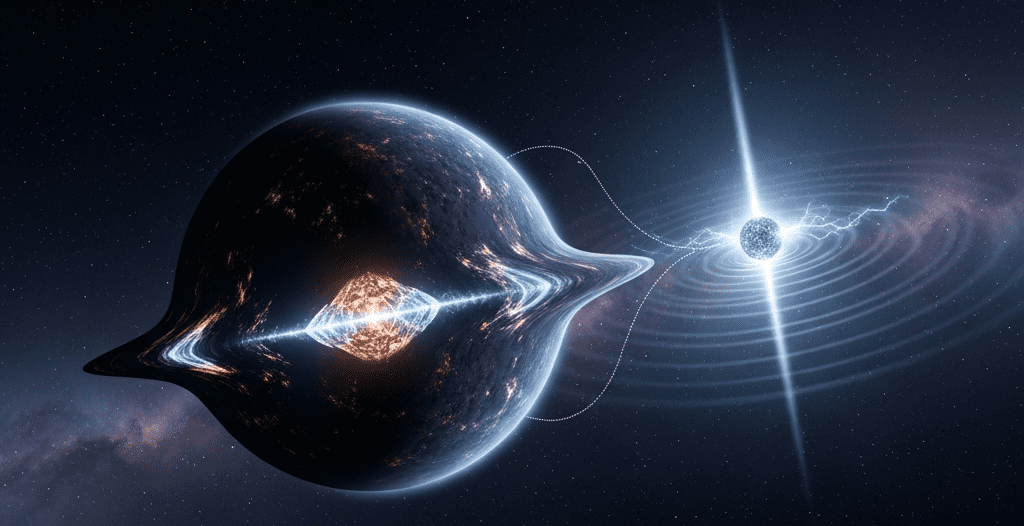
Unlike the gas giants in our solar system, which are primarily hydrogen and helium, PSR J2322-2650b boasts an atmospheric composition that is utterly alien. Researchers from the University of Chicago have identified a cocktail dominated by helium and heavy carbon, leading to a sky filled with dark, soot-like clouds. But the intrigue doesn’t stop at the clouds. Under the crushing gravitational pressures of this massive world, scientists believe that carbon is compressed into a crystalline state—meaning this planet likely hides a core made of solid diamond.
Orbiting a City-Sized Powerhouse
The environment surrounding this planet is as extreme as the world itself. It orbits a pulsar—a rapidly spinning neutron star that packs the mass of our entire Sun into a sphere the size of a metropolitan city. This unique pairing allowed for a rare observational opportunity. Because pulsars emit most of their energy as high-energy gamma rays rather than infrared light, the JWST was able to observe the planet throughout its entire orbit without the host star overwhelming the sensors.
The technical data reveals a world under incredible stress:
- Orbital Speed: The planet completes a full trip around its star in under eight hours.
- Tidal Distortion: The pulsar’s intense gravitational pull has physically stretched the planet into a distinct, lemon-like shape.
- Atmospheric Mystery: The presence of carbon-rich gases defies current models of how planets orbiting pulsars should form.
Why This Discovery Changes Everything
Standard planetary theory suggests that a world this close to such a violent stellar remnant should have been stripped away or never formed in the first place. Yet, PSR J2322-2650b remains—a soot-shrouded enigma that principal investigator Michael Zhang describes as a “completely bizarre” discovery that caught the team by absolute surprise.
This discovery is a spectacular reminder that the universe is far more creative than our current theories allow. As this research moves toward publication in The Astrophysical Journal Letters, the global astronomical community is now racing to explain how this “diamond-hearted lemon” came to be. It’s not just a new planet; it’s a new category of existence.
Source: Read the full article here.