
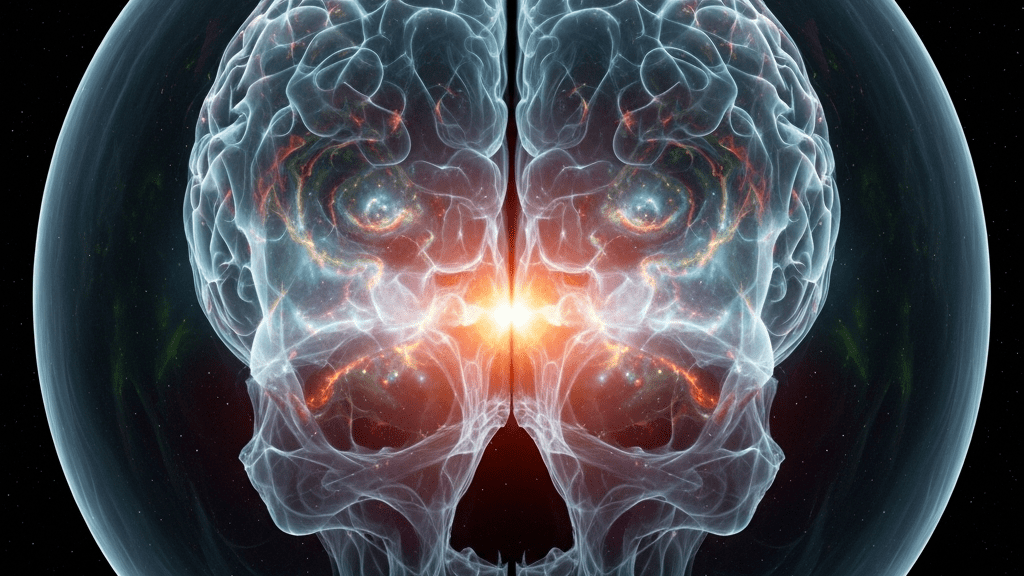
The James Webb Space Telescope (JWST) has done it again, capturing an image that is as scientifically significant as it is visually haunting. Astronomers have long been fascinated by PMR 1, a nebula nicknamed the "Exposed Cranium," but Webb’s latest infrared observations have revealed a level of structural complexity that was previously invisible to our most advanced observatories.
A Cosmic Brain in the Deep Sky
Located in the depths of our galaxy, the Exposed Cranium nebula (PMR 1) is a breathtaking example of a planetary nebula—the glowing remains of a dying star. While NASA’s Spitzer Space Telescope first identified this object over a decade ago, its low-resolution infrared view only hinted at the nebula’s true form. Thanks to Webb’s superior optics, we can now see a remarkably symmetrical structure that eerily resembles the human brain, complete with two distinct hemispheres and a transparent outer "skull" of gas.
Decoding the Layers of Stellar Death
The high-definition data provided by Webb’s Near-Infrared Camera (NIRCam) and Mid-Infrared Instrument (MIRI) allows us to dissect the nebula’s anatomy with surgical precision. The structure is composed of several distinct evolutionary phases:
- The Outer Shell: A vast, translucent sphere of hydrogen gas, representing the star’s initial expulsion of material as it began its final descent.
- The Central Lane: A dark, vertical divide that splits the nebula into its iconic brain-like hemispheres. This feature is likely the result of dense dust and gas masking the light from the inner region.
- Internal Jet Activity: Webb’s high-resolution imaging suggests that the central star is driving powerful, bipolar jets. These jets of energy are likely responsible for pushing gas outward and carving the intricate lobes we see today.
The Power of Multi-Wavelength Observation
What makes this specific observation so compelling is the synergy between NIRCam and MIRI. While NIRCam excels at capturing the delicate filaments of gas and the stars themselves, MIRI penetrates deeper into the dust, revealing the cooler material and the energetic outflows near the nebula’s poles. In the MIRI images, scientists have noted significant movement where internal gases are being forced into the outer shell, providing a real-time look at the kinetic energy shaping the cosmos.
Why the Exposed Cranium Matters
Beyond its striking appearance, the Exposed Cranium nebula serves as a vital laboratory for understanding the final stages of stellar evolution. By studying the layered gas and the impact of central jets, astrophysicists can better predict how stars—including our own Sun—will eventually shed their mass and enrich the surrounding interstellar medium with the heavy elements necessary for future generations of stars and planets. This is a brief, dramatic window into a star’s final act, and Webb has given us a front-row seat.
Source: Read the full article here.