In the vast, seemingly slow-moving theater of the cosmos, most events play out over millions or even billions of years. However, every so often, the universe delivers a high-speed spectacle that happens right before our eyes. Thanks to the unprecedented infrared precision of the James Webb Space Telescope (JWST), astronomers have finally solved a long-standing mystery: what exactly happens to the survivors of a cataclysmic stellar collision?
The Mystery of the Luminous Red Nova
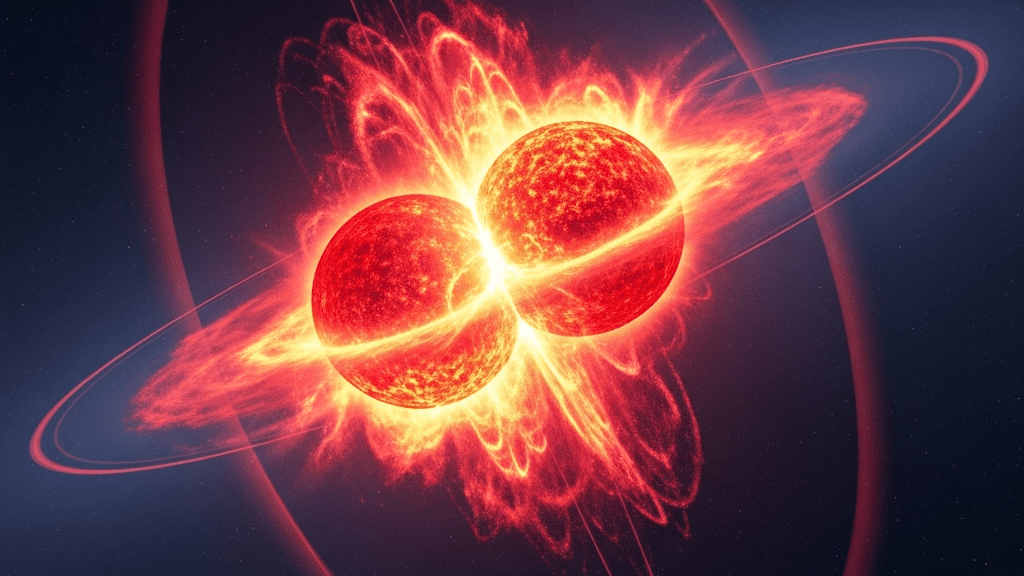
When two stars in a binary system spiral into one another and merge, they trigger a massive explosion known as a “luminous red nova” (LRN). These events are fascinating because they sit in a unique cosmic middle ground. They are significantly brighter than classical novas—which occur when a white dwarf siphons material from a companion—but not quite as energetic as the terminal supernovas that signal the death of a massive star.
While we have witnessed these flashes for years, the aftermath has remained shrouded in mystery. Once the light from the explosion fades, what is left behind? A new study led by Andrea Reguitti of the Istituto Nazionale Di Astrofisica (INAF) has utilized JWST’s archival data to provide a definitive answer: these collisions result in the birth of a supermassive star, structurally similar to a red supergiant.
Witnessing Evolution in Real-Time
One of the most exciting aspects of this research is the timescale. Most stellar evolution is far too slow for human observation, but luminous red novas are different. These transients evolve over months or years, allowing astronomers to watch a system undergo a radical transformation in “real-time.”
- Rapid Evolution: The transition from two distinct stars to a single merged entity occurs over a few months, a blink of an eye in cosmic terms.
- The Progenitors: By looking at archival images taken years before the merger, researchers can identify the original stars, which range from the mass of our Sun to 50 times its size.
- The Aftermath: The JWST observations focused on nine specific events, with two particular cases—AT 2011kp and AT 1997bs—providing the most comprehensive data yet.
A Cosmic Forge for Life
This discovery isn’t just about the mechanics of stellar mergers; it has profound implications for our own existence. The study found that these stellar collisions serve as a vital source of raw materials. As the stars merge and explode, they eject heavy elements and complex dust into the surrounding interstellar medium. These are the very ingredients required for the formation of planets and, ultimately, the biological building blocks of life.
The New Era of Stellar Archeology
By studying systems like AT 2011kp in the galaxy NGC 4490 (located 25 million light-years away) and AT 1997bs (31 million light-years away), JWST is allowing us to perform “stellar archeology.” We can now see the before, during, and after of these violent encounters. The realization that these mergers create stable, supermassive red giants changes our understanding of how stars evolve in dense environments.
As we continue to dive into the JWST archives, we are moving closer to understanding the full lifecycle of the stars that populate our universe—and the violent events that paved the way for us to be here today.
Source: Read the full article here.